Flow at Work: Designing Meaningful Days
How to create the conditions for deep engagement and creativity
After my vacation, I’ve been reflecting on what it really means to enjoy work — not just to finish tasks, but to feel fully absorbed by them. Mihaly Csikszentmihalyi’s classic book Flow reminded me that the quality of our experience isn’t shaped only by what happens outside us. It depends on how much control we have over our inner world — our attention, our focus, and the meaning we assign to challenges.
At work, my best moments often come from “detective-style” tasks: bug fixing, tracing issues, experimenting with AI tools. I forget time, lose self-consciousness, and the work feels like play. That’s flow. The book gave me language for why it happens — and how to invite more of it into daily work.
1. Flow balances challenge and skill
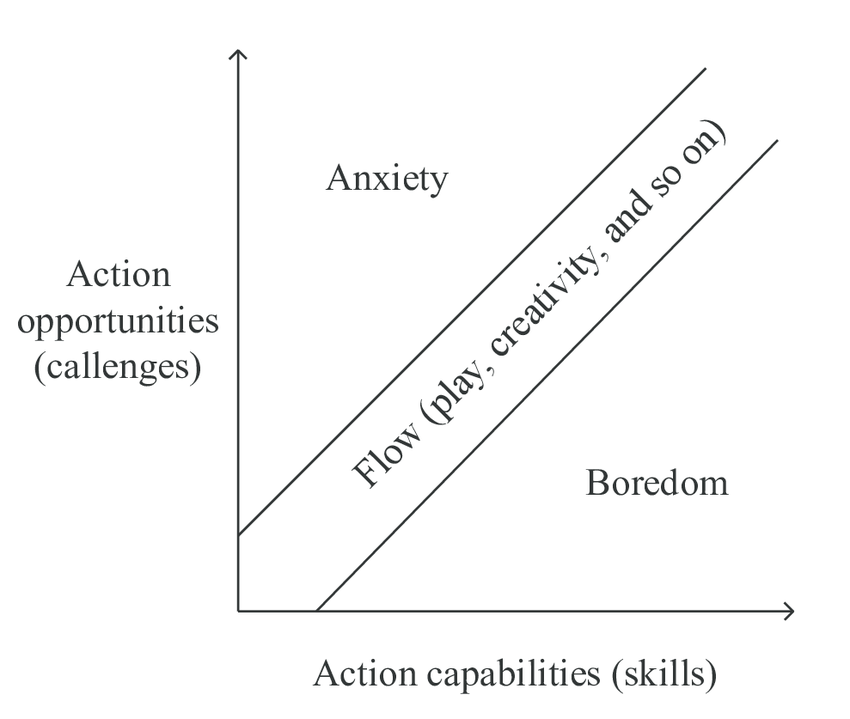
If something is too easy, we drift into boredom. If it’s too hard, we tense into anxiety. Flow happens in the narrow middle zone, where challenge and skill rise together.
“Flow occurs when challenges and skills are both high and equal to each other.”
2. Clear goals and feedback are essential
Flow requires direction. We need to know what we’re aiming for — and to get direct signals about progress.
“In flow, there is no room for self-scrutiny. The feedback is immediate: we know instantly whether we are succeeding or failing.”
3. Concentration is the gateway
To enter the zone, attention has to be protected. When we give work our full focus, distractions fall away and immersion deepens.
“Concentration is so intense that there is no attention left over to think about anything irrelevant, or to worry about problems.”
4. Flow dissolves the self — and strengthens it
In flow, self-consciousness fades. Yet afterward, we emerge more confident and capable, having stretched our abilities.
“Self-consciousness disappears, yet after an episode of flow the self is stronger than before.”
5. The joy is in the doing
Flow is autotelic — the activity is its own reward. It’s not just about reaching goals, but about the quality of experience while pursuing them.
“The self becomes complex as a result of experiencing flow. It is not the goals we pursue that matter, but the quality of experience while pursuing them.”
Why it matters for work
Coming back to work, I want to design my days with these conditions in mind — seeking the right challenges, setting clear goals, building feedback loops, and protecting focus. Flow isn’t just a “nice bonus.” It’s what makes work feel meaningful.